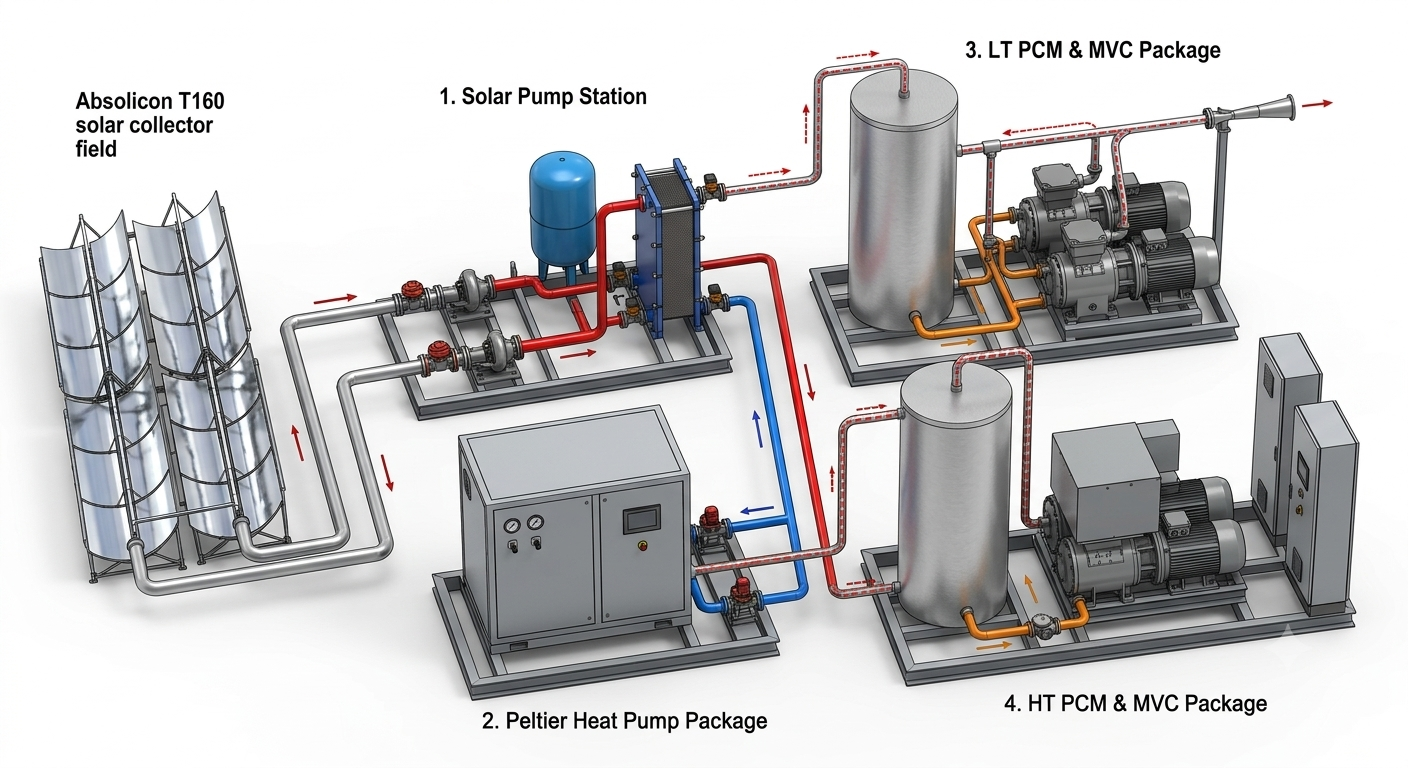
Coal Zero by Green Steam is an industrial decarbonization solution designed to deliver reliable process steam without coal combustion. The system combines renewable heat, thermal storage, heat pump technology, and intelligent controls to provide continuous steam for industrial operations.
The first deployment is planned as a pilot in South Africa, with the goal of demonstrating a scalable model for food and beverage industries and other energy-intensive sectors.
How the system works
From sunlight to industrial-grade steam.
Solar heat capture
Solar collectors capture heat and deliver thermal energy into the steam generation process.
Thermal storage
A phase change material storage unit stores heat and helps maintain stable steam production.
Steam upgrading
Low-temperature steam is upgraded through a high-efficiency compression system to reach industrial operating conditions.
Feedwater preheating
Feedwater is preheated before entering the boiler circuit, which improves overall energy efficiency.
Digital optimization
A digital control layer continuously optimizes operation, tracks performance, and supports remote monitoring.
Deep dive
How each technology works.
SKID 01 . SOLAR PUMP STATION
Solar collector field & pump station
– Absolicon T160 concentrating solar thermal Single-axis parabolic trough collectors, Solar Keymark certified with >76% optical efficiency. Pressurised water operates at 85–120°C, rated up to 160–170°C at 16 bar. The 432-collector pilot array includes 24 tracking units, with a 25-year design life and defined degradation rates.
– Solar pump station A closed-loop system transfers solar heat through a plate heat exchanger, isolating the process. Redundant pumps, differential control and a three-way valve route heat to the LT or HT PCM, allowing higher-temperature solar to bypass compression. The package includes pumps, heat exchanger, expansion vessel, safety valves and control panels, feeding Skid 03 and Skid 04.
SKID 02 . PELTIER HEAT PUMP PACKAGE
Turning the plant's rejected heat into useful heat
Solid-state thermoelectric (Peltier) modules transfer heat using electricity, with no refrigerant and no moving parts in the thermal circuit. The system operates quietly and has zero global warming potential.
SKID 02 is integrated into the make-up water and condensate return system. It recovers heat from the dairy ammonia chilling system and upgrades it for use in the LT PCM, reducing the amount of heat required downstream from the PCM boiler.
The package includes 10 Peltier modules with heat spreaders and clamps, dedicated power electronics, source- and load-side pumps, and a local PLC for system control. The system is rated for operation up to 3 bar.
SKID 03 . LT PCM & MVC PACKAGE
Storing the heat and starting the lift
– Low-temperature PCM thermal battery A 1 MWh PCM thermal battery stores solar heat as latent heat at 85 °C, stabilising compressor suction despite solar variability. It charges from solar, Peltier heat, condensate and HT PCM return, and discharges saturated vapour to the MVCs. The unit uses food-grade PCM, pressure-rated casing, corrosion-resistant cladding and low-maintenance access.
– Mechanical vapour compressors (MVC 01 & 02)
Three-stage, oil-free R718 compressors recover latent heat through vapour recompression instead of fuel combustion. MVC 01/02 operate in parallel, with MVC 03 providing the final lift. Designed for 1 t/h steam output with COP ≈5.5, supported by VFDs, electrical panels and condition-monitoring instrumentation.
– Dynamic steam ejector
Uses high-pressure steam from MVC 03 to entrain low-pressure vapour and raise suction pressure to MVC 01/02. Dynamic modulation optimises compressor power consumption and replaces a conventional vacuum system.
SKID 04 . HT PCM & MVC PACKAGE
Final lift to process steam and the brain of the plant
– High-temperature PCM thermal battery A second-stage latent store receiving compressed steam, high-grade solar heat and condensate. PCM stores heat up to 200 °C, decoupling steam supply from solar and grid availability. It supplies MVC 03 and cascades condensate to the LT PCM.
– Final compressor, steam conditioning & condensate recovery MVC 03 provides the final lift to 178 °C at 8.7 barG. A desuperheater delivers saturated steam to the existing process header. Condensate is recovered through the HT and LT PCMs, reusing sensible heat within the closed clean-steam loop.
– Master SCADA, IoT & digital twin Master SCADA coordinates all skids, optimising solar, PCM and compressor dispatch, with predictive compressor monitoring and remote dashboards. Verified steam data supports usage-based billing. Measurement uses ISO 5167-2:2022 Class 1.0 flowmeters, IEC 60751 RTDs, EN 837-1 pressure transducers, EN 50470 MID submeters and ISO 9060 pyrheliometers, with monthly DIN EN ISO 12242 ultrasonic checks and hashed audit logs.
Performance
Specification
8,760
tons Annual steam production
178
°C Saturated steam condition
20.09
% Thermal energy from solar
1
ton/hour Steam output
Business Model
Heat as a Service
Instead of requiring the client to invest in the full capital cost upfront, the customer pays for steam delivered under a long-term service contract. This model reduces adoption risk, improves affordability, and supports long-term performance monitoring. It also allows clean steam to compete with conventional fossil-based steam on an operational basis.
HaaS
Heat or Steam as a Service, billed on delivered output.
Fixed price
Long term contracts insulate clients from fuel and carbon
volatility.
Buyout
Optional client buyout of the system after year 10.
Phase 1 is a funded demonstration with a real industrial off-taker. Phase 2 turns that reference plant into a repeatable, locally fabricated product line.
Phase 1
Pilot Demonstration
March 2026 – August 2027
RFG Foods, Groot Drakenstein, Western Cape, South Africa
1 ton/hour
Deploy and commission the 1 t/h Coal Zero clean steam system
Integrate Absolicon T160 solar collectors, PCM thermal storage, Peltier heat pump and three-stage R718 mechanical vapour compressor
Operate continuously at 178 °C saturated steam under real industrial loads
Validate performance via SCADA, IoT sensors and third-party audits
Demonstrate 2,754 tonnes CO₂e avoided annually
Generate validated data to unlock blended finance for replication
Phase 2
Full-Scale Deployment
Subject to Stage 1 KPI verification
RFG Foods scaled up, plus replication across South Africa
9 tons/hour
Scale up to 9 t/h system for continuous clean steam delivery to RFG
Expand to 5 and 10 t/h modular skids across 500+ eligible SA industrial sites
Begin local fabrication in Cape Town’s Atlantis SEZ from 2028
Target 100 t/h aggregate capacity by 2030
Create 300+ direct jobs and 1,200+ by 2035
Expand to Nigeria, Kenya and Botswana by 2035
Gender Equality & Social Inclusion
GESI in Training & Employment
The project integrates a dedicated GESI Action Plan to ensure women, youth, and underrepresented groups in the Cape Winelands industrial region benefit directly from the transition to clean industrial heat, using targeted training, mentorship programmes, diversified hiring, and women-focused procurement to open fair access to jobs, skills, and opportunities across the local industrial ecosystem.
Technical Training for Women
50%
≥ 50% female engineering trainees
Workforce Diversification
40%
≥ 40% women & youth in new O&M hires
Mentorship Programs
> 2
≥ 2 mentees per project year participating in mentorship
Procurement Targets
1
At least 1 contract awarded to a local women owned enterprise.
Food & Beverage Processing
Canneries (e.g., Rhodes Food Group), beverage bottlers, dairies, and breweries requiring continuous 100°C–180°C steam for sterilization, cooking, and pasteurization.
Agro-Processing & Textiles
Drying facilities, sugar mills, and textile dyeing plants seeking zero-carbon thermal energy via Heat-as-a-Service (HaaS) contracts to eliminate upfront CAPEX.
Pharmaceutical Manufacturing
Facilities needing oil-free, food-grade steam delivery with reliable temperature holds and strict emissions compliance.
👥 Key System End Users
Operators, Engineers & Local Community Stakeholders
Factory Energy Engineers
Plant managers monitoring automated steam flow, pressure metrics, and fault alerts via the integrated SCADA/IoT cloud control dashboard.
Local Technical Operations Crew
Maintenance technicians trained under the project's GESI initiative, with targeted 40%+ participation for women and youth in O&M roles.
Corporate Sustainability Officers
Executives seeking verified Scope 1 decarbonization data (e.g., ~2,754 tons CO₂e avoided/year) for ESG audit reporting.
Consortium Partners
A consortium of complementary expertise
Lead consortium coordinator, responsible for heat pump development & PCM integration.
System integration, modelling, and long-term performance monitoring.
Provider of high-efficiency Concentrated Solar Power (CSP) collector field.
Academic oversight on Social Inclusion, GESI Framework execution, and impact tracking.
Design and delivery of the novel 3-stage R718 steam mechanical compressor.
Commercial lead executing the Heat-as-a-Service (HaaS) delivery model and co-financing
Local deployment lead, environmental & social safeguard execution, local stakeholder bridge.